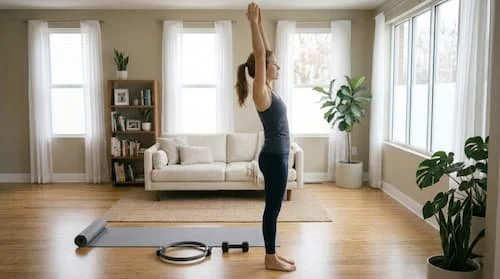
Some mornings, your knees, hips, or hands feel stiff before your day has even started. You get up from the floor and something complains. Maybe it's new, maybe it's been creeping in for a while. And somewhere in the back of your mind is a worry: if I exercise, will I make it worse?
That worry keeps a lot of women moving less. But moving less usually makes stiffness worse, not better. The answer is not to push through, and it is not to stop. It is to move in a way your body can work with.
Why joints get stiffer and achier
Part of it is simply aging. As we get older, we tend to get stiffer, and we lose muscle if we don't keep it up. For women, changing estrogen may also play a role. Research suggests it could be linked to joint aches, along with other factors, and it can start before periods stop. It's not one proven cause, and the evidence is still developing.
A helpful rule of thumb: morning stiffness that eases within about 30 minutes is common. See your doctor if you have sudden or severe pain, swelling, or stiffness that lasts more than an hour.
Why keep moving
Regular movement helps keep your joints mobile and flexible. And strong muscles support the joints around them, so they don't have to do all the work alone.
What Pilates gives you
To me, Pilates is about re-educating your body in how to move. When you learn to control your joints, your core, and your breath, you have a solid base to build on.
It also works with gravity in a helpful way. In my sessions, I start by having you practice alignment in a supported position, on the floor or with equipment. Then we move gradually through different positions: on your stomach, on your side, seated, and then kneeling, which is mild weight bearing. Finally we get to standing, where your joints take your full weight. Along the way you get many chances to practice good alignment before gravity is fully loading the joint. That lets you build strength with less pressure on your joints and spine, so your muscles do more of the work.
And it works on mobility, keeping your range of motion as the years go by.
Want help with this one-on-one? I teach live private Pilates on Zoom. See details here.
Why you also need added load, and why it isn't all or nothing
If you’re on a GLP-1 or wondering whether Pilates alone is enough, I wrote about why heavy lifting matters and how to add it safely.
Pilates alone usually isn't heavy enough to build real strength, but heavy lifting isn't right for everyone either. We start with a load your joints can handle and build it up gradually. Too much, too fast can irritate joints, so the pace should match you.
Online, the load depends on what you have, from just your body weight to bands, hand weights, or a reformer. Changing your position, from lying down to kneeling to standing, also changes how much your muscles and joints have to handle. So you can build strength even if you don't own any equipment.
This is where the re-education matters. When you know how to move well, you lift better, and your body is ready for more.
How I teach it
Every session is built around you: your goals, your body, the equipment you have, and how much time you have. If you want straight Pilates, that's what we do. If you want to build strength, we add load gradually, alongside the Pilates.
In a private session I watch your form in real time and adjust, so you build a balance of strength and flexibility. You need both: strength to support your joints, and flexibility to keep them moving freely.
Questions I hear often
Is Pilates good for joint pain?
It can help many people. Pilates builds control and mobility in positions that take pressure off your joints, and you can add load gradually to build strength. It isn't a treatment.
Will strength training make my joints worse?
Too much weight too fast can irritate joints, but you don't have to avoid strength. The load is matched to you.
Do I need equipment?
Not to get started. Sessions work with whatever you have, or just a mat. If your goal is to build heavier load, you may want to buy some weights or bands, depending on what you're working toward. I can work with any budget, and I'll help you choose what's worth getting, if anything.
How often should I do it?
One session a week is plenty. You get a replay of each session for a week, so you can practice in between, and you can add more sessions whenever you want extra support.
Is it too late to start?
No. Whether you're new to Pilates or have done it for years, we start from where you are today.
Do I need to be flexible?
No. Flexibility is something you build, not something you need before you start.
When to check with a doctor or physio?
If your pain is persistent, sudden, or severe, or comes with swelling, get it checked first. This post is general information and not medical advice.
Ready to try it?
If you'd like help building strength and moving better without aggravating your joints, I teach live private Pilates on Zoom.
You can see the details and book here: travilatesfitness.com/privates
Want more support between sessions? My full Pilates coaching program, with practice videos, check-ins, and form checks, isn't open yet. Curious what it could look like for you? I'm only taking 3 when the waitlist opens. Join the waitlist and I'll be in touch when spots open.
Melissa Van is a Pilates teacher, retreat leader, and writer based between the US and Europe. After 20+ years of teaching, she created travilates, which offers 1:1 online Pilates coaching for women 45 and up. She leads lively retreats that bring movement and travel together, open to women at any stage of life. She also writes Notes from the Road, a weekly Substack on staying steady in midlife, one city at a time.