Do You Need Heavy Lifting If You Already Do Pilates?
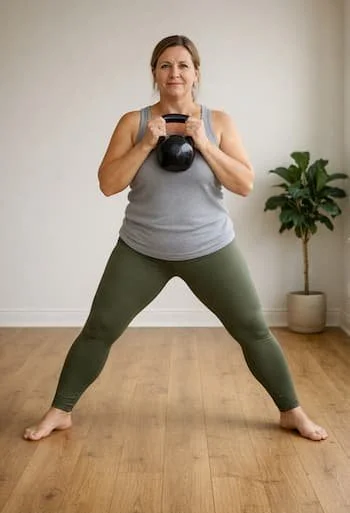
You're doing your Pilates. Maybe some yoga too. You feel stronger, steadier, more like yourself. So when someone tells you that's not enough, that you also need to be lifting heavy, it's easy to feel like the ground just moved.
Here's the thing. For healthy aging, and especially for bone density and muscle mass, Pilates and yoga are doing genuine work, but they're often not doing this particular work. And if you're on a GLP-1, this matters even more. Rapid weight loss doesn't just take fat. It takes muscle too, and a lot of women don't find that out until the muscle is already gone.
This isn't only a perimenopause conversation, either. If you're in midlife and beyond, whether you're deep in perimenopause, post-menopausal, or somewhere in between, your muscle and bone health are already on the same clock, and the same rules apply.
So no, your Pilates practice hasn't failed you. It just isn't the whole picture.
Why this matters even more if you're on a GLP-1
Muscle is metabolically active tissue. It's what keeps your resting metabolism running day to day. So when a GLP-1 helps you lose weight quickly, and a meaningful share of that loss is muscle, not just fat, your metabolism is losing ground right along with the number on the scale.
Here's the part that doesn't get talked about enough. Most people don't stay on these medications forever. And when someone comes off without a strength program already in place, a lot of that weight tends to come back. The problem is, it doesn't come back the same way it left. Muscle is far harder to rebuild than it was to lose, especially after midlife, when your body simply doesn't respond to training the way it once did. So the weight that returns often comes back more as fat than the muscle that was lost.
That's the real risk. Not just regaining weight, but ending up with a different body composition than you started with, less muscle, more fat, and a metabolism working against you instead of for you. Building and protecting muscle while you're losing weight is the best insurance you have against that outcome, and it's why this isn't a "nice to have" for anyone on a GLP-1. It's essential.
Want to start protecting your muscle today, not just read about it?
Grab a free 5-minute strength audio, no equipment, no gym required.
Join the Waitlist → (write "strength" in your message and I'll send it over)
Heavy lifting isn't one size fits all
This is where most generic advice falls apart. "Just start lifting" sounds simple until you're the one standing in a gym wondering what's safe for your spine, your joints, your history.
Bone density, past injuries, joint wear, whether you have osteoporosis or osteopenia. All of it changes what heavy lifting should look like for your body specifically. What's a smart, strengthening load for one woman can be genuinely dangerous for another, even if they're the same age and doing the same class.
I saw firsthand how dangerous that can be.
What 20 years of teaching has shown me
In 20 years of working with clients, I've seen this pattern more than once: someone adds a personal trainer alongside our work, and that trainer doesn't take her specific condition into account. The results aren't small. Women end up hurt.
Osteoporosis is the clearest example. Twisting under heavy load is one of the most dangerous things you can ask a body with fragile bones to do, and it happens more than you'd think, sometimes as early as a first session, before a trainer has taken the time to fully understand what they're working with.
That's not a small oversight. For someone with fragile bones, that kind of forceful spinal rotation is exactly the movement pattern that raises fracture risk. General fitness credentials don't automatically come with an understanding of bone-safe movement. That gap is real, and it's why I think about heavy lifting so differently than most trainers do.
Heavy lifting, the Pilates way
This is where I think Pilates has something to offer that a lot of strength programs don't. A lot of gym training isolates. One machine for your legs, another for your back, a third for your arms, each part working on its own. Pilates trains the opposite. Your whole body learns to move together, as one connected system, in every single movement.
That difference is what makes heavy lifting safe. When you lift as a whole body instead of one isolated part doing the work while everything else just goes along for the ride, the load spreads out. Your spine isn't left to absorb what an untrained pattern throws at it. For a body dealing with bone loss, past injury, or decades of wear most trainers never even ask about, that whole-body coordination isn't a nice bonus. It's the thing that keeps the lift safe in the first place.
So instead of sending you off to figure out a separate lifting program on your own, I can build it into our sessions. Heavy, bone-loading work, chosen for your body and your history, folded into the same hour you're already showing up for.
You don't need a whole second program bolted onto an already full life. Even ten minutes of well chosen heavy lifting, built right into your Pilates-based session, covers what your body needs. Safely, and without adding one more thing to your week.
One session, everything handled.
How this fits into your week
You shouldn't have to become your own physical therapist to know if a workout is safe for your bones. That's my job. Every week, I design around where you are: your energy, your goals, what your body's asking for that week.
I keep my roster small on purpose. Real personalization doesn't scale. When the waitlist opens, I'm only taking 3.
Join the waitlist now for a free 5-minute strength audio, no equipment, anywhere, anytime.
When you sign up, please write "strength" in the message field so I know to send you the audio.
Layer it in or use it alone. Not perfection. Just something every day.
Join the Waitlist →
Melissa Van is a Pilates teacher, retreat leader, and writer based between the US and Europe. After 20+ years teaching, she built travilates: 1:1 online Pilates coaching for women 45 and up, plus retreats that bring movement and travel together for women at any stage of life. She writes Notes from the Road, weekly reflections on staying steady in midlife, one city at a time.